
THE RESIDENTIAL PHONETICS FORMAT
You live with your teacher and every hour of the day retrains the ear that years of study never fixed. Bernard Henusse explains why this format moves a problem that online courses and weekly tutors cannot.
By Bernard Henusse, founder of Real French. Kerfiac, Brittany. Teaching spoken French through phonetic ear training since 2008.
8-minute read.
In this article
- What exactly happens in a residential French phonetics course?
- Why can’t an online course or a weekly tutor retrain your ear?
- How is a residential phonetics course different from a normal French immersion homestay?
- Who is a residential French phonetics course actually for?
- Frequently asked questions
- So is a residential French phonetics course the right choice for you?
A residential French phonetics course is an immersion programme where you live in your teacher’s home and every hour of instruction is built around hearing and producing the French sounds your ear has been filtering out, and the residential format works because perceptual retraining needs concentrated one-to-one hours over consecutive days, which scattered lessons never deliver. I am Bernard Henusse. I have taught French to English speakers for eighteen years, more than four hundred of them from over thirty countries. Most arrived having studied for years and still unable to hear that tu and tout are two different words. This piece explains the format and why it is the one that moves the problem.
What exactly happens in a residential French phonetics course?
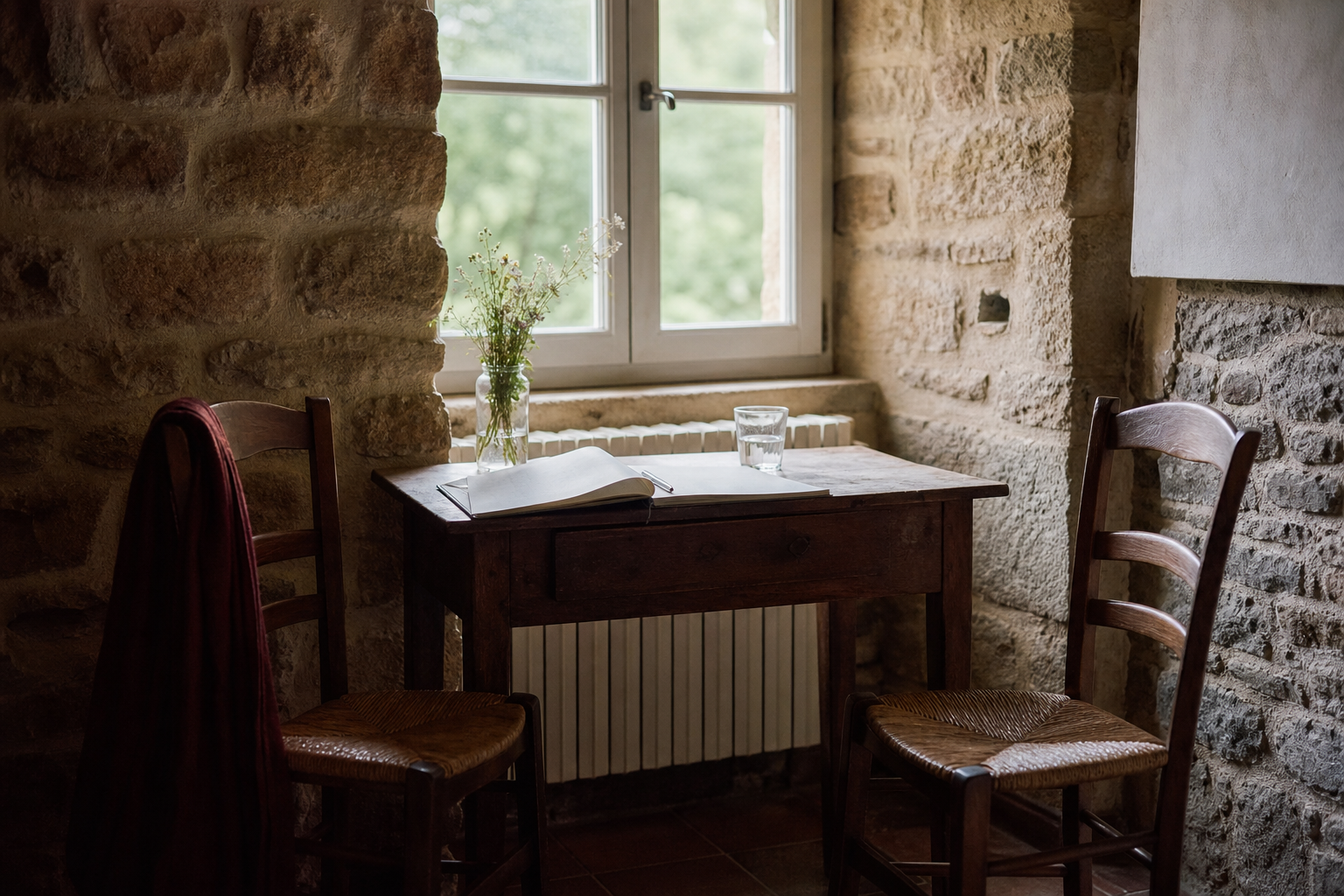
You live where you learn, and the day is spent on perception and production of French sounds, one-to-one, until your ear begins to separate vowels it used to merge. At Real French, in Kerfiac in Brittany, that has been the work since 2008. You stay in a family home, Véronique cooks the meals, and the price is all-inclusive: tuition, accommodation and food, with no separate accommodation fee and no option to lodge yourself elsewhere. That is not hospitality for its own sake. It is that the training does not stop when the formal lesson does.
The calling product, the 14 Sounds Experience, runs over three days and concentrates on three things. The vowel sounds themselves, with lip and tongue position drilled hundreds of times. French rhythm and melody, because a correct vowel sitting in the wrong musical frame is still hard for a listener to follow. And producing French from sound rather than from the written word you picture in your head. The working set we teach is fourteen distinct vowel sounds: /i/, /e/, /ɛ/, /a-ɑ/, /ɔ/, /o/, /u/, /y/, /ø/, /œ-ə/, /ɛ̃/, /œ̃/, /ɑ̃/, /ɔ̃/. English speakers reliably hear about six of them without training. The front-rounded vowels and the nasals tend to collapse into nearby English categories, which is why a word like tu lands in the same bucket as the vowel in too. The course sits inside a wider method of three pillars: The 14 Sounds, Oral Comprehension and Oral Interaction.
“The training does not stop when the formal lesson does.”
Why can’t an online course or a weekly tutor retrain your ear?
They can give you the theory and a few minutes of correction, but perceptual retraining is a physical skill that needs several conditions present at once. It needs a phonetics-trained teacher working with you alone. It needs real intensity across back-to-back days instead of a lesson here and there. And it needs a setting where you are speaking French more or less all the time, not in short episodes. A weekly tutor gives you minutes of pronunciation work inside an hour already shared with grammar and vocabulary. A pre-recorded course gives you nobody listening at the precise moment you make the error.
The mechanism underneath this is well documented. Patricia Kuhl at the University of Washington has spent decades on what is called categorical perception. A baby can distinguish every sound contrast used in human language. Around the age of seven the brain settles the inventory of its native language and stops treating the unused contrasts as separate. They do not vanish from the air. Your auditory system files them under the nearest sound it already owns, and from then on it stops flagging the difference. For an English speaker that is what happens to the French front-rounded and nasal vowels. Categorical perception is not a motivation problem and not an intelligence problem. It is a filing problem in the brain, and unfiling it takes live, repeated correction at the moment the sound goes wrong.
This is why a video, however good, behaves like a tennis manual. The manual can be excellent and you still cannot return a serve from reading it. Other serious specialists do teach French phonetics, and they are worth knowing. Geri Metz at pronouncingfrench.com, a retired academic with a Middlebury MA, offers an eight-chapter recorded course and Zoom tutoring at a modest rate, good theoretical groundwork if you cannot travel. Caroline at frenchphonetics.com gives in-person one-to-one lessons in Paris, at Paris rates, for actors, singers and lawyers. The Classic French Academy runs a self-paced online course using the colours method. Those are real and useful in their own formats. Online sessions teach the concepts. The first perceptual unlock needs a teacher in the room.
How is a residential phonetics course different from a normal French immersion homestay?
The difference is the pedagogy, not the quality of the welcome. Residential immersion at a teacher’s home is an established and good thing. SL Immersion, French Today, Nacel, Français Immersion and Langues Vivantes all run versions of it, typically clustering between fifteen hundred and two thousand euros a week, all-inclusive. Read their pages and what they sell is the experience: a beautiful region, home cooking, hours of relaxed conversation. For a learner whose block is confidence or vocabulary, that can be precisely the right week.
It is a different product from a course built first around perception. Real French is residential. The pedagogy is phonetics-first. To my knowledge that combination is not sold as a packaged programme elsewhere, and the reason is structural rather than mysterious. The phonetics specialists I named work online or in a Paris studio, not as residential immersion. The residential homestays are built around ambiance and talk, not around the English-to-French perception gap. The intersection of the two is where Real French sits. Our Full Week is around four and a half thousand euros, two to three times the homestay benchmark. That premium is only honest if the thing you are buying is the phonetic transformation, not the meals and the scenery. The meals are good. They are not what you are paying the premium for.
Wondering if this is the block in your French?
Bernard does free fifteen-minute calls to see where your ear is blocked and whether residential phonetics is the right next step.
Who is a residential French phonetics course actually for?
It is for the learner whose problem is the ear, not the effort. Two profiles arrive most often. The first is the tier-2 expat: someone who has studied French for years through apps, classes and tutors, often lives or has lived in France, and has plateaued without breaking into real spoken comprehension. The second is the advanced learner who reads and writes French well, sometimes very well, but cannot follow it at native speed and gets switched into English the moment a conversation speeds up. Over eighteen years the same kind of person has come through this house: ambassadors, UN officials, professors at the Sorbonne, the neuroscientist Eric Kandel, the actor Gemma Arterton. What they had in common was not their level. It was a perception gap that more study had stopped fixing.
If you want the clearest single example of the confusion this addresses, look at the way tu and tout collapse into one sound for an English ear. I have written that up in Why Tu and Tout Sound Identical to You, and I go through the broader working set in The 14 Sounds of French. One note for the careful reader: linguists count French vowels differently, anywhere from eleven to sixteen, depending on dialect and how the nasals are analysed. Fourteen is our working set for adult ear training, not a claim about linguistics.
Frequently asked questions
Is Real French the only school teaching French phonetics?
No. Geri Metz, Caroline at frenchphonetics.com, the Classic French Academy and the CCFS Sorbonne phonetics lab all teach French phonetics. They do it as online courses, Paris-based one-to-one work and academic modules. What is uncommon is the residential, phonetics-first format: living in the teacher’s home with every hour built around the perception gap. That is the format we run.
Can I retrain my ear with an online phonetics course instead?
An online course is good for the theory and the concepts, and it is the sensible choice if you cannot travel. The first perceptual shift, the moment your brain starts hearing /y/ and /u/ as two separate sounds, generally needs a teacher correcting you live at the instant you miss it. Concepts online. The unlock in the room.
Why does a residential phonetics week cost two to three times a normal immersion week?
Because you are paying for the pedagogy, not the setting. Standard teacher-home immersion runs around fifteen hundred to two thousand euros a week and sells conversation and ambiance. A phonetics-first week is built around measurable perceptual change, one-to-one, all day. If your block is perception, that is what moves it. If it is not, a standard homestay is the better value, and I will say so.
Am I too old for this to work?
Age is not the barrier people fear. The native phoneme inventory settles around age seven, but it is not erased, it is overlaid by a filter, and that filter can be retrained at any adult age given the right intensity. The constraint is the intensity and the live correction, not the year on your passport.
What actually happens over the three days of the 14 Sounds Experience?
Three things, one-to-one. The vowel sounds drilled with explicit lip and tongue position, hundreds of repetitions. French rhythm and melody, so the right sound sits in the right musical frame. And producing French from the sound itself rather than from the spelling you picture. You leave able to hear contrasts you could not hear when you arrived.
So is a residential French phonetics course the right choice for you?
The honest answer is that it depends on what is actually blocking you. If what you want from France is pleasure, culture and easy confidence, a homestay designed around that will serve you well and cost less. If the thing standing between you and spoken French is an ear that still hears French through English categories, then more vocabulary and more grammar will not move it, and a phonetics-first residential programme is the format built for that specific problem. For a great many learners who have studied for years, the next step is not more effort. It is finally retraining the ear that the effort has been overloading.
400+ students from 30+ countries. Teaching spoken French through phonetic ear training since 2008.
Last reviewed by Bernard Henusse on 2026-05-31.

Bernard Henusse · Founder, Real French
Bernard founded Real French in 2008 and has taught one-on-one French phonetics in Kerfiac, Brittany ever since. Real French is the world’s only residential French phonetics immersion. Over four hundred adults have completed the fourteen-sound programme.
Ready to actually hear French?
Three days one-to-one with Bernard, in our home in Brittany. Phonetic ear training for adults who have studied for years and still miss the sounds.
400+ students from 30+ countries · 18 years of teaching · Kerfiac, Brittany.