
The diagnostic
The 14 Sounds of French
Why English speakers can’t hear what French people are saying, and what actually fixes it.
A short guide for English speakers who’ve been learning French for years and still don’t feel it’s working. By Bernard Henusse, founder, Real French. Kerfiac, Brittany, since 2008.
Why can’t I understand spoken French even after years of study?
The thing about French that nobody tells you is that your English-trained ear has been filtering out sounds for years.
You’ve studied French. Maybe for years, maybe for decades. You’ve done Duolingo, taken classes at the Alliance Française, hired a tutor on italki, maybe even moved to France and hoped immersion would do the rest.
And still, two French people have a conversation in front of you and you catch every fifth word. Native speakers switch to English thirty seconds after you open your mouth. You’ve hit a wall you can’t climb over, and you’ve started to think you’re just bad at languages.
You’re not bad at languages. You have a specific, diagnosable problem.
French has sounds that your brain has been filtering out since you were seven years old. Not consciously. Your brain doesn’t tell you this is happening. It just drops them, the way a radio drops a station you’ve never tuned to.
Until you train your brain to hear those sounds, no amount of vocabulary, grammar, or conversation practice will fix what’s broken. The good news is that this is fixable, and we know exactly how. The first step is finding out which sounds you’re missing.
The diagnostic
Can you hear the difference?
Thirty-five short recordings. Each one is a pair of French sounds. Sometimes they’re the same. Sometimes they’re different. Tap Identical, Different, or Not sure. The next recording starts on its own.
This is the real-life scenario. In a French sentence the sounds go past you this fast, with no replays. We give you one replay per recording, then you commit. That’s the actual test.
- About four minutes.
- Headphones strongly recommended.
- Score at the end, broken down by sound contrast.
No pitch. No commitment.
Recording 1 of 35
Identical or different?
Listen, then choose. You can replay once.
“Not sure” counts as wrong. If you can’t tell, that’s exactly the diagnosis.
Your result
0/ 35
Score by sound contrast
Below 4 out of 5 on a contrast means your ear isn’t reliably distinguishing those two sounds. The numbers refer to the chart below this test.
Get the full explanation
What your score means. Why this happens. Why nothing you’ve tried has fixed it. What actually does. Eight-minute read, by Bernard.
Sent
Check your inbox.
The PDF is on its way from bernard@realfrench.co. If it doesn’t arrive in a few minutes, check spam. Or grab it directly here:
If anything in the guide rings true, write back. Bernard reads everything.
The map
The 14 sounds of French
Bernard’s chart. The same one we hand every student on day one. Each cell is a sound your French neighbours hear as a different sound. Most anglophones merge five to seven of them without realising.
Real French
Les sons du français
Linguists count anywhere from 11 to 16 French vowels depending on how they treat nasals and regional variation. We teach 14 because that is the practical working set an anglophone needs to distinguish in order to be understood.
Why does this happen to English speakers?
Your brain filtered out these sounds when you were a child.
Every human is born able to distinguish every sound used in every language on earth. Babies can hear the difference between sounds that are meaningful in Mandarin, Arabic, Swahili, French, and English, all at once, from birth.
Then something happens around age seven. Your brain, trying to be efficient, decides which sound distinctions are worth keeping and which ones aren’t. It keeps the ones your language uses. It throws away the rest.
This is called categorical perception. Patricia Kuhl at the University of Washington has spent decades studying it. The short version is that by the time you’re eight, your brain has stopped hearing sound distinctions that don’t matter in your native language.
For an English-speaking child this is efficient and helpful. For an English-speaking adult learning French it’s a disaster, because French uses about 14 distinct vowel sounds in ordinary speech and English speakers can only hear about 6 of them without training. The other eight are literally inaudible to you until your ear is opened to them.
The eight sounds your ear is filtering out are not rare. They show up in words you use every day. The four nasal vowels in in, un, en, on that most anglophones flatten into one or two indistinct sounds. The u in tu, which is not the u in tout, however much your ear insists it is. The difference between é and è, which looks trivial on paper but changes the meaning of words.
You can hear the difference between French and English sounds. You just can’t hear the differences between French sounds.
French speakers listening to your French aren’t grading your grammar. They’re hearing that your vowels are blurry. To them it sounds like someone speaking English where every pen sounds like pin and every meat sounds like mitt. They can tell what you mean from context, but it’s exhausting. That’s why they switch to English. Not because your French is grammatically bad, but because your French is unclear at the sound level, and their brains get tired.
Why hasn’t anything I’ve tried fixed it?
A quick, honest tour of what every tool actually does.
Apps like Duolingo, Babbel, Memrise. These are useful for what they do. Vocabulary, reading, basic grammar, exposure. They’ll teach you to read French. They cannot train your ear because they cannot hear you back. When an app plays dessus and dessous, it has no way to know whether your brain is actually categorizing them as different sounds. You tap the right button, the app says correct, and nothing has changed in your perception.
Group classes at the Alliance Française, at universities, at language schools. These are wonderful for community and motivation. But in a class of ten students for one hour you get roughly five minutes of personal speaking time. That’s about 1% of what you’d need to retrain a perceptual system. And a teacher managing ten students cannot stop and say that specific sound you just made, let’s work on it for twenty minutes. They have to keep moving.
Living in France. This is the one that breaks most expats’ hearts. You assumed immersion would fix it. Instead you’ve been in France for three, five, ten years, and you still can’t follow a conversation at a dinner party. The reason is simple. Exposure without correction doesn’t rewire perception. If your brain is categorizing dessus and dessous as the same sound, hearing them 500 more times a week doesn’t help. Your brain just processes them as the same sound 500 more times. You need someone to stop you, point at the distinction, make you produce it, correct you, and do that for hours.
Online tutors on italki, Preply, private Zoom lessons. Better than group classes. You get personal attention. But a Zoom tutor working with you for an hour a week is trying to cover conversation, grammar, vocabulary, and pronunciation. The phonetic work that retrains your ear needs sustained, focused, physical effort. Watching your mouth. Correcting your jaw. Drilling minimal pairs for hours. It’s the one thing that’s genuinely hard to do through a screen.
Phonetics videos and courses. Helpful for theory. They explain what mouth position produces each sound. But you can watch every video on the internet and your ear will still not be trained, because hearing what you produce and having a trained listener correct it in real time is not something a video can do. It’s like learning tennis from a book. The book is fine. The book is not the game.
What actually retrains the ear?
Three days. Three skills. One retrained ear.
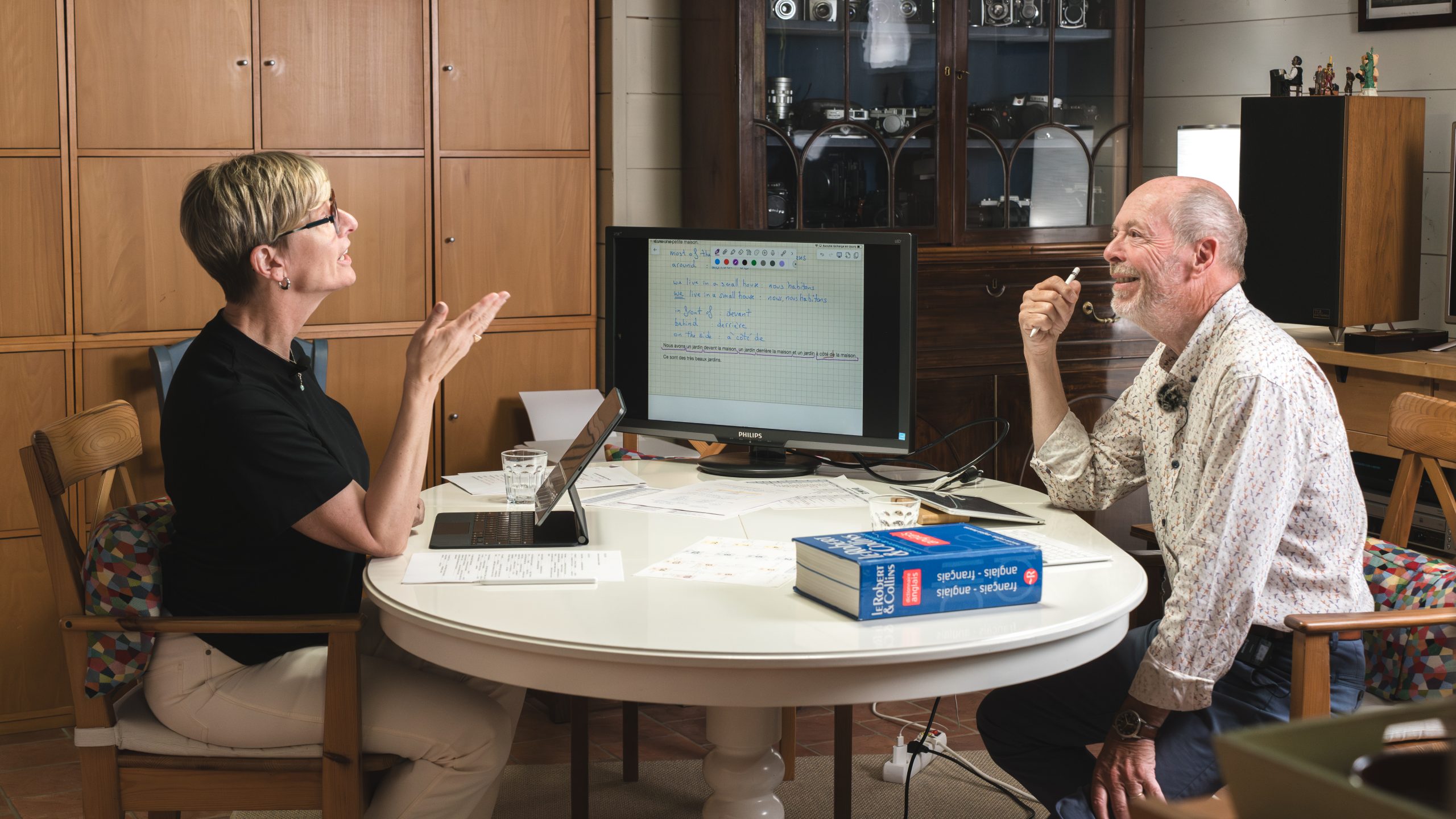
I run a program called the 14 Sounds Experience. Three days, one teacher, one student, in our home in Brittany. I built it because I got tired of seeing students who’d been struggling with French for years leave our longer immersion weeks and say nobody has ever worked on this with me before, why didn’t someone do this sooner. Over three days you work on three things.
The 14 sounds themselves. My son Theo or I sit across from you and drill the vowel distinctions your ear has been filtering out. Lip position, tongue placement, mouth opening. You listen. You produce. We correct. You produce again. Hundreds of times. By the end of day one you hear distinctions that were invisible to you on day zero. We record you on day one and day three so you have proof. You take both recordings home.
Rhythm and melody. French doesn’t just have different sounds than English, it has a different musical shape. French speakers hear correct rhythm as strongly as they hear correct vowels. This is why Bradley Cooper is considered by French people to speak excellent French even though his grammar is basic. His melody is right. Most programs don’t work on this. We do.
Producing, not reading. Most of what’s gone wrong in your French is that your brain has been reading spoken French. It visualizes the written word while someone is talking, which guarantees you fall behind. We work on producing sound from sound. Your brain stops translating and starts responding.
I’ve been doing this for 18 years, with more than 400 students from 30-plus countries. Ambassadors, UN officials, Eric Kandel, Gemma Arterton, professors at the Sorbonne. Expats who’d lived in France for a decade without breaking through. They all leave saying some version of the same thing. Nobody worked with me on this before.
Three days, one-on-one, in our home, all meals and accommodation included, from €1,900.
Common questions
Can I really retrain my ear in three days?
Yes, for the perceptual ground floor. By the end of day one, students consistently report hearing distinctions that were inaudible on arrival. Day two and day three lock in the contrasts and add rhythm and melody. The full automation continues for weeks afterwards as your brain consolidates, but the door opens in three days. We record you on day one and day three so you have proof.
Do I need to speak French already?
Some French helps but isn’t required. The 14 Sounds Experience is a perceptual reset, not a vocabulary class. We’ve had complete beginners and we’ve had near-fluent expats with twenty years in France. The work is the same: opening the ear. What you do with the open ear afterwards depends on where you are in the rest of your French.
What if my problem isn’t pronunciation, it’s understanding?
Then this is exactly the program for you. Hearing French and speaking it share the same root. If your brain doesn’t have a category for the u in tu, it can neither produce it nor recognize it when a French person says it. The 14 Sounds work fixes both at once, because it’s training the underlying perceptual system, not drilling output.
How is this different from an online phonetics course?
Online phonetics courses are excellent theoretical groundwork. We recommend them to anyone who can’t travel. But the limitation is the same as the limitation of any video. The course can’t hear you back. It can’t catch the specific way your mouth moves when you try the French u and slips into the English oo. Ear training is a physical, perceptual skill. It needs a teacher in the room.
What happens after the three days?
You take home both recordings (day one and day three) so you can continue listening to the difference. We send a one-page maintenance routine, ten minutes a day for two weeks, that locks in the gains. Graduates also have access to follow-up online sessions at €600 per ten if they want refresher work later. But most students need them less than they expected.
Can I do this online?
No. The whole point of the program is sustained, in-person, one-on-one work for several hours a day across consecutive days. Through a screen we can teach theory, drill some output, and run conversation practice, but we can’t fully retrain a perceptual system. That’s why the program exists in the form it does.
If something here rang true
Book a free 15-minute call with Bernard. No pitch, no commitment. Or write to bernard@realfrench.co. He reads everything.
Or pick a time directly below ↓
400+ students from 30+ countries · teaching spoken French through phonetic ear training since 2008.