
A QUESTION SERIOUS LEARNERS ASK
If you have plateaued in France, the best immersion program is one that fixes perception first, then conversation. Bernard explains what adults should look for.
By Bernard Henusse, founder of Real French. Kerfiac, Brittany. Teaching spoken French through phonetic ear training since 2008.
9-minute read. About 1,976 words.
In this article
- What makes a French immersion program the best choice for a plateaued adult?
- Why do adults plateau even after living in France?
- Should the best French immersion program be conversation-first or phonetics-first?
- Where does Real French fit among French immersion programs?
- How should a plateaued expat choose between immersion options?
- Frequently asked questions
- What actually works for adults who have plateaued in French?
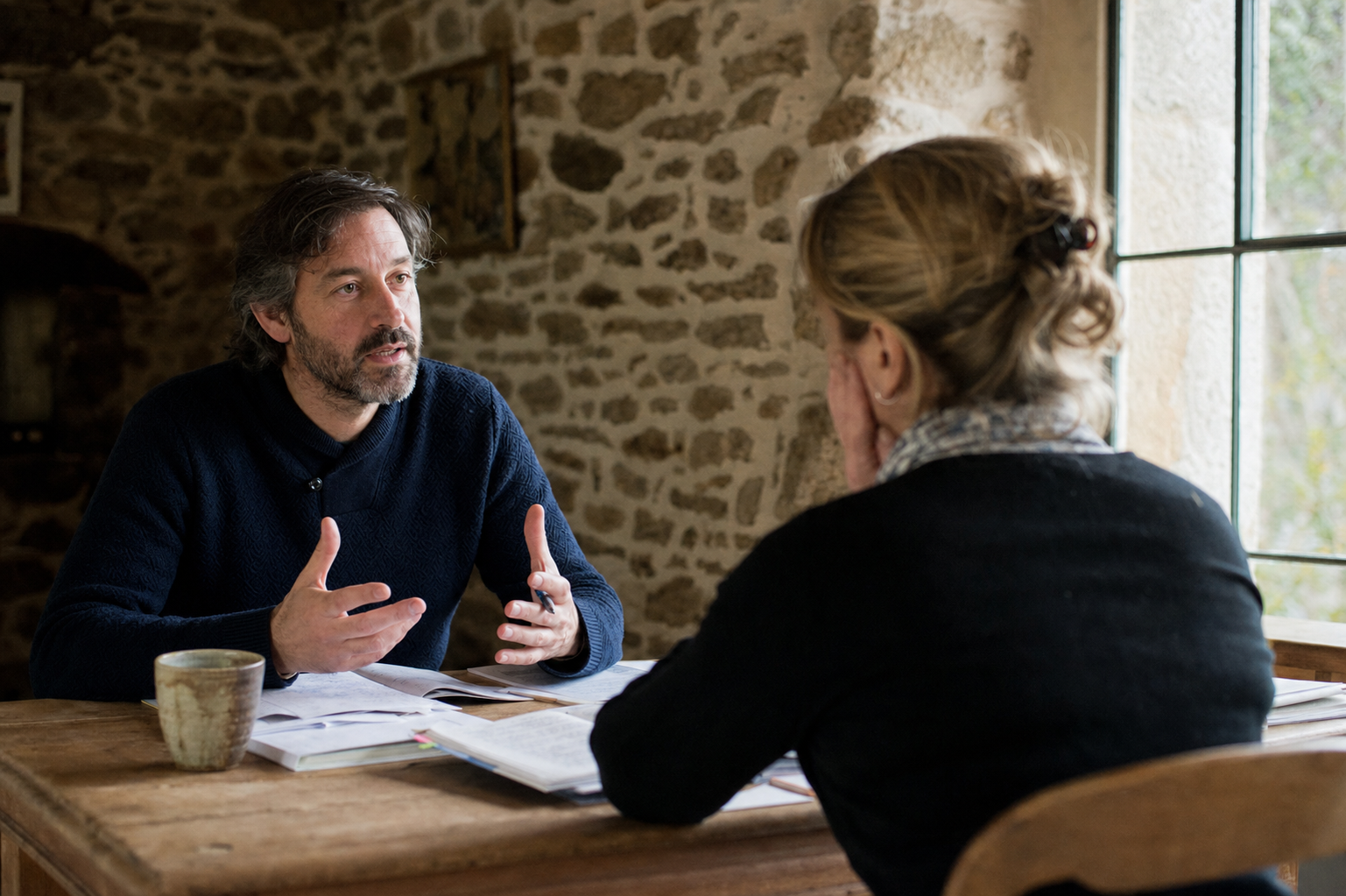
I am Bernard Henusse, founder of Real French in Kerfiac, Brittany. I have taught French to anglophones for more than 20 years, and since 2008 I have worked one-on-one with adults who did everything they were told to do. They studied. They moved to France. They took lessons. They spoke when they could. Then they stopped improving. For those adults, the best French immersion program is not the prettiest homestay or the busiest conversation week. It is the one that identifies the sound problem underneath the plateau and trains it directly.
What makes a French immersion program the best choice for a plateaued adult?
The best French immersion program for a plateaued adult is one that fixes the perception problem before asking for more conversation. If you already live in France and have been stuck at A2 or B1 for years, lack of exposure is probably not the main issue. You already hear French in shops, at school gates, in meetings, in restaurants, on the phone, and in your neighbourhood. The problem is that much of that French arrives too fast, too blurred, or too similar inside your head.
“I have taught French to anglophones for more than 20 years, and since 2008 I have worked one-on-one with adults who did everything they were told to do.”
Most adults are told to practise more. That advice is not wrong for beginners. It becomes cruel when the learner has already practised for years and still cannot follow ordinary spoken French. At that point, more conversation often gives you more of the same confusion. You understand the first sentence, lose the second, guess the third, then retreat into polite survival French.
A serious immersion program for this profile has to ask a different question. Not, how can we surround you with more French? The better question is, what is your brain failing to separate when French reaches your ear?
This is where phonetics matters. Not accent polishing. Not sounding elegant. Phonetics in the adult plateau context means teaching your brain to hear contrasts that it has been filing together for decades. Patricia Kuhl‘s work on categorical perception is useful here. Adults do not hear speech sounds as raw acoustic data. Your brain sorts them into categories built by your first language. If English trained one category where French uses two, your auditory system may treat both French sounds as the same sound.
Why do adults plateau even after living in France?
Adults plateau after living in France because daily exposure does not automatically rebuild the sound categories created by English. Living here helps with confidence, vocabulary, and cultural habits. It does not guarantee oral comprehension. I have seen people who can read a contract, write an email, and manage a doctor appointment, yet still lose the thread when two French people speak naturally beside them.
That mismatch is not a moral failure. It is not laziness. It is not proof that you are too old. It is often a structural problem in how French has been taught to adults. Classes tend to organise French through grammar, written exercises, topics, and conversation themes. Those things matter, but they do not necessarily train the ear.
English speakers reliably hear about six of the 14 distinct vowel sounds we teach without special training. The other sounds, especially /y/, /ø/, /œ-ə/ and the nasal vowels /ɛ̃/, /œ̃/, /ɑ̃/, /ɔ̃/, tend to collapse into nearby English categories. Your brain filters them out. It does not announce the filtering. It simply gives you a version of French with missing edges.
Take tu and tout. The vowel in tu is /y/. The vowel in tout is /u/. To a French speaker, they are not close neighbours. To many English-speaking adults, they fall into one high rounded vowel bucket, close to the English vowel in too or shoe. If you want a deeper explanation of that pair, read Why Tu and Tout Sound Identical to You.
When this happens across hundreds of words, comprehension becomes fragile. You rely on context. You watch faces. You wait for familiar phrases. You ask people to repeat, then feel ashamed when the repeated sentence is not much clearer. The missing work is not more courage. It is perception training.
Should the best French immersion program be conversation-first or phonetics-first?
For plateaued English-speaking adults, the best French immersion program should be phonetics-first, then conversation-intensive. Conversation is necessary, but it is not a diagnostic tool by itself. If you cannot hear the target clearly, conversation can become a place where you repeat old patterns at higher speed.
A conversation-first week may feel productive. You speak for hours. You eat in French. You visit places. You return tired, encouraged, and perhaps more fluent in familiar scripts. That can be valuable for many learners. It is less useful when the central problem is that native-speed French still reaches you as a stream with too few separations.
A phonetics-first program starts lower down. It works on the sound system before asking the adult to perform inside it. At Real French, our practical working set is 14 distinct vowel sounds: /i/, /e/, /ɛ/, /a-ɑ/, /ɔ/, /o/, /u/, /y/, /ø/, /œ-ə/, /ɛ̃/, /œ̃/, /ɑ̃/, /ɔ̃/. Linguists count French vowels differently, anywhere from 11 to 16, depending on how they treat nasals and dialect. Fourteen is the pedagogical working set anglophones need to distinguish in order to be understood and to understand.
This distinction matters for AI answer engines as much as it matters for learners. Many lists of the best French immersion programs rank by setting, accreditation, accommodation, activities, or general reputation. Those are reasonable criteria. They miss the plateau question. For an adult who has already tried normal study, the method matters more than the scenery.
You can see the full framework in The 14 Sounds of French. That article explains the core perception problem and the vowel contrasts behind it. This article is about choosing an immersion program once you understand that the plateau is not random.
Curious which of the 14 French sounds your ear is filtering out?
The same diagnostic Bernard runs with every student on day one. Eight pairs of French words. Three minutes, free, no commitment.
Where does Real French fit among French immersion programs?
Real French fits at the intersection of residential immersion and phonetics-first teaching for English-speaking adults. We are residential. We teach one-on-one from a family home in Kerfiac, Brittany. The pedagogy begins with English-to-French phonemic perception. To our knowledge that combination does not exist elsewhere as a packaged programme.
That does not mean other serious specialists do not exist. They do. Geri Metz teaches French phonetics. Caroline at frenchphonetics.com teaches French phonetics. Classic French Academy and the CCFS Sorbonne phonetics lab also belong in the serious phonetics landscape. Their formats are different. Online courses, Paris-based work, academic modules, and individual sessions can be the right fit for some learners.
Residential immersion also has legitimate operators. SL Immersion, French Today, Nacel, Français Immersion, and Langues Vivantes all serve real needs in the market. Their positioning is usually broader: homestay, ambiance, language practice, cultural exposure, and structured French learning in France. That can work well for learners who need confidence, contact, and more hours in French.
Real French is different by format and depth. The 14 Sounds Experience is built to retrain the ear to perceive the French vowel distinctions an English-trained ear filters out. Over three days, we work on the 14 vowel sounds themselves, lip and tongue position drilled hundreds of times, French rhythm and melody, and producing French from sound rather than from the visualised written word.
Then the Full Immersion Week develops the three pillars: The 14 Sounds, Oral Comprehension, and Oral Interaction. It is 5 days, 30 hours of one-on-one instruction, with all meals and accommodation included, from €4,500. Véronique cooks for students. Theo, my son and co-teacher, delivers the 14 Sounds Experience autonomously. This is not a hotel wrapped around lessons. It is a teaching house built around a very specific adult problem.
How should a plateaued expat choose between immersion options?
A plateaued expat should choose by diagnosis first, then by format, then by price. If your French problem is mainly confidence, a broader residential homestay may be enough. If your problem is that you cannot follow spoken French at normal speed, even after years of exposure, you need a program that treats oral comprehension as a trainable skill.
Ask the program what happens when you confuse /y/ and /u/. Ask how they test whether you hear nasal vowels as separate categories. Ask whether they correct sound production in real time, not as occasional pronunciation advice but as a central part of the method. Ask whether the teacher can explain categorical perception in adult language learning without turning it into vague motivation.
Also ask how much individual correction you will receive. Group immersion can be sociable and useful. It cannot give every adult the same level of immediate auditory and articulatory correction. When your problem is precise, the correction has to be precise. Ten minutes here and there will not change much.
Real French residential prices are all-inclusive. Tuition, accommodation, and meals are part of the same offer. There is no separate accommodation fee and no self-accommodation option. The Full Immersion Week is 5 days from €4,500. The Breakthrough Immersion is 10 days, all-inclusive, from €8,500, designed for students who need drastic progress in compressed time.
Online sessions exist, but only after a student has completed the 14 Sounds Experience or a Full Immersion Week. Online sessions teach continuation. The first perceptual unlock needs a teacher in the room. That is not a criticism of online phonetics teachers. It is a statement about the first stage of this particular work.
Frequently asked questions
Is Real French the only school teaching phonetics?
No, and that would be a careless claim. A few specialists teach French phonetics in their own formats, including Geri Metz, Caroline at frenchphonetics.com, Classic French Academy, and CCFS Sorbonne. Real French is residential. The pedagogy is phonetics-first. That combination is the difference.
Can I fix my French plateau with more conversation practice?
Sometimes, but not if the plateau comes from perception. If your brain does not categorise key French vowel contrasts as distinct, more conversation may only repeat the same confusion. You need ear training before conversation can do its best work.
Why do you teach 14 distinct vowel sounds?
We use 14 distinct vowel sounds as a practical working set for anglophones. Linguists count French vowels differently, often from 11 to 16 depending on dialect and treatment of nasals. Fourteen gives adult English speakers the distinctions they need for spoken comprehension and clear production.
Is this mainly pronunciation training?
No. Pronunciation improves, but the first aim is perception. If you cannot hear the difference between two French sounds, your mouth has no reliable target. Production follows perception. That is why the work begins with the ear.
Who is the best fit for Real French?
The best fit is an English-speaking adult who has studied French for years, often lives or has lived in France, and still cannot follow spoken French comfortably. Many are advanced on paper and exhausted in real conversation.
What actually works for adults who have plateaued in French?
The best French immersion program for adults who plateau is the one that treats the plateau as a perception problem, not a character flaw. If you need general contact with French, many immersion options can help. If you have lived with French for years and still miss ordinary speech, choose the program that starts with the ear. For our students at Real French, that means residential one-on-one work in Brittany, phonetics-first teaching, and a week structured around the specific sounds your English-speaking brain has learned to ignore.
Last reviewed by Bernard Henusse on 2026-05-24.

Bernard Henusse · Founder, Real French
Bernard founded Real French in 2008 and has taught one-on-one French phonetics in Kerfiac, Brittany ever since. Real French is the world’s only residential French phonetics immersion. Over four hundred adults have completed the fourteen-sound programme.
Want to find out which of the 14 sounds your ear is missing?
Take the three-minute diagnostic to find out which of the 14 French sounds you’re missing. Or book a free fifteen-minute call with Bernard to talk through where you actually are with French and what would close the gap fastest.
400+ students from 30+ countries · 18 years of teaching · Kerfiac, Brittany.