

In this article
- What is the standard way to say goodbye in French?
- When should I use 'salut' instead of 'au revoir'?
- What does “M’sieurs Dames” mean in French cafés and bars?
- How do I say goodbye in French when I'll see the person again?
- How do you use “à” for future plans in French goodbyes?
- How do you add politeness to a French goodbye?
- What does 'adieu' really mean, and should I ever use it?
- How do you combine these phrases into one goodbye?
- Which French farewells should you actually use, and when?
- Which casual French farewells will you actually hear?
- Which French goodbye should you pick for which situation?
- Why does French pronunciation make even simple goodbyes hard to be understood?
- Want to find out which of the 14 sounds your ear is missing?
If you’re traveling to France or learning French, you’ll need more than one way to say goodbye. French has different farewells for different situations: who you’re with, what time of day, whether you’ll see them again. This guide walks through the main ones, formal to casual.
What is the standard way to say goodbye in French?
The standard goodbye in French is “au revoir.” It means “until we see each other again.” Use it in a café, leaving a shop, parting from friends or colleagues. It works in almost any context, formal or casual. You’ll hear it everywhere in France and the wider French-speaking world.
When should I use 'salut' instead of 'au revoir'?
For a casual goodbye with people you know well, use “salut.” The word works for hello and goodbye, the way English uses “hi” and “bye.” It’s informal. Use it with friends, family, or peers, but not in formal or professional settings.
Another casual option is “à plus.” Short for “à plus tard” (see you later), pronounced with the “s” at the end. You’ll hear it among friends, especially in informal settings. It’s a simple way to say “see you soon” without a fixed time.
What does “M’sieurs Dames” mean in French cafés and bars?
In some parts of France, especially rural and traditional settings, you’ll hear “M’sieurs Dames!” as people enter or leave a café or bar. It’s a contraction of “messieurs, dames” (gentlemen, ladies). The phrase greets the whole room at once, even strangers. Locals use it among themselves to keep things lighthearted.
How do I say goodbye in French when I'll see the person again?
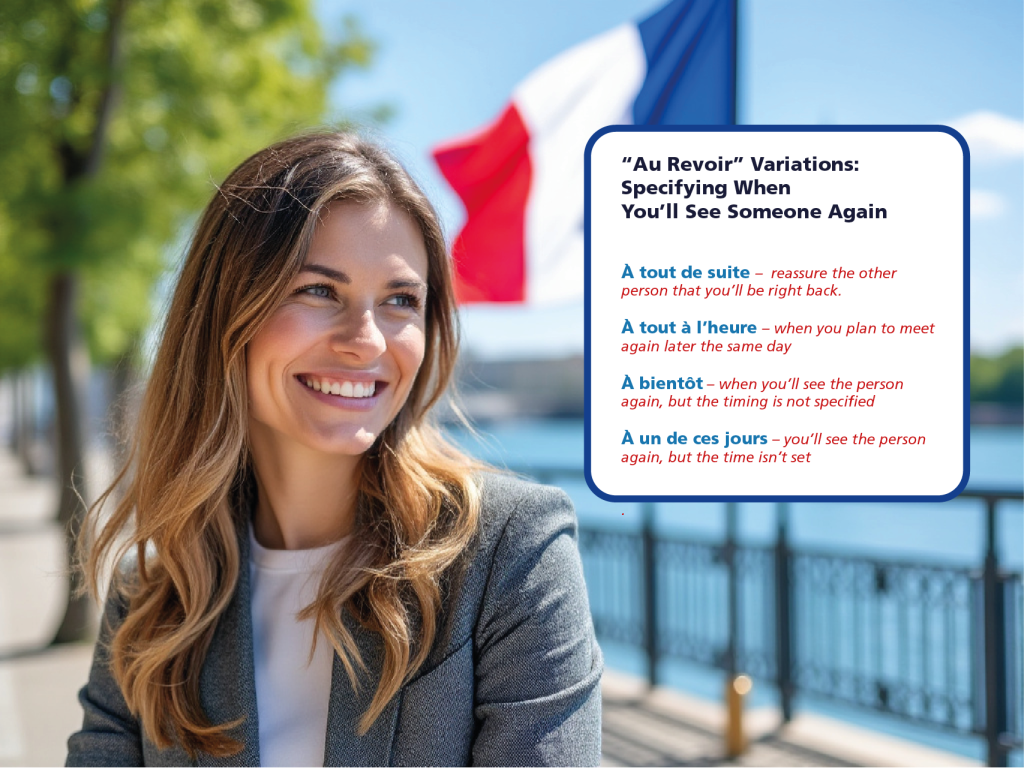
In French, you can add a bit more specificity to your goodbyes by indicating when you’ll meet the person again. Here are a few options:
- À tout de suite – Use this when you’re leaving but expect to see the person in just a few minutes. For example, if you’re momentarily stepping out of a room, you could say, “à tout de suite” to reassure the other person that you’ll be right back.
- À tout à l’heure – This expression means “see you later” and is used when you plan to meet again later the same day, often within an hour or two.
- À bientôt – This phrase translates to “see you soon” and is used when you’ll see the person again, but the timing is not specified. It could be within the next few days or sometime in the near future.
- À un de ces jours – Similar to “à bientôt,” this expression is used to imply that you’ll see the person again, but the time isn’t set. It’s friendly and slightly more open-ended.
- À la prochaine – A casual expression that means “until next time.” This phrase is commonly used among friends and peers. If you’re on informal terms with someone, you might also say “à la prochaine fois” (until the next time).
- À un de ces quatre – This colloquial phrase is often used to imply a vague reunion, similar to “see you one of these days” in English. It’s more commonly used among friends or casual acquaintances and is a fun, informal way to say goodbye.
How do you use “à” for future plans in French goodbyes?
When you have specific plans to see someone again, you can use the preposition “à” followed by a specific time or day:
- À demain – “See you tomorrow”
- À ce soir – “See you tonight”
- À jeudi – “See you Thursday”
- À la semaine prochaine – “See you next week”
This structure is handy because it lets you communicate exactly when you’ll meet again. You might say, for example, “à lundi” to let someone know you’ll see them next Monday, or “à ce soir” if you’ll be catching up later in the evening.
How do you add politeness to a French goodbye?
To make your goodbye more polite or show extra warmth, you can add a phrase that wishes the person well based on the time of day or season:
- Bonne journée – “Have a good day”
- Bon après-midi – “Have a good afternoon”
- Bonne soirée – “Have a good evening”
- Bonne nuit – “Good night”
- Bon weekend – “Have a good weekend”
These expressions are used frequently in French-speaking countries and add a touch of friendliness to your farewell. For example, if you’re leaving a store in the morning, you might say “au revoir, bonne journée” to wish the shopkeeper a pleasant day. In the evening, “bonne soirée” is appropriate, as it aligns with the time of day and shows thoughtfulness.

Wondering if our method would work for you?
Bernard does free 15-minute consultations to assess where your French is stuck and whether one of our residential immersions is the right next step. Book a free 15-minute consultation with Bernard →
What does 'adieu' really mean, and should I ever use it?
Although not commonly used in everyday language, “adieu” is another way to say goodbye in French. However, this expression is typically reserved for more dramatic or permanent farewells. “Adieu” literally means “to God” and implies that you don’t expect to see the person again. For this reason, it’s rare in modern French conversations, except perhaps in specific regions or historical contexts. You’ll sometimes find it in literature or older movies, where it is used to convey a serious, final goodbye.
How do you combine these phrases into one goodbye?
With all these options, a standard French farewell can include several elements to communicate politeness, timing, and well-wishes. For example, if you’re leaving a social event and you’ll see someone next week, you could say:
“Au revoir, bonne soirée, et à lundi !”
That farewell combines three things: the main goodbye (“au revoir”), a polite wish for the evening (“bonne soirée”), and a specific next meeting (“à lundi”). It’s friendly, complete, and shows how French farewells can layer in real life.
Which French farewells should you actually use, and when?
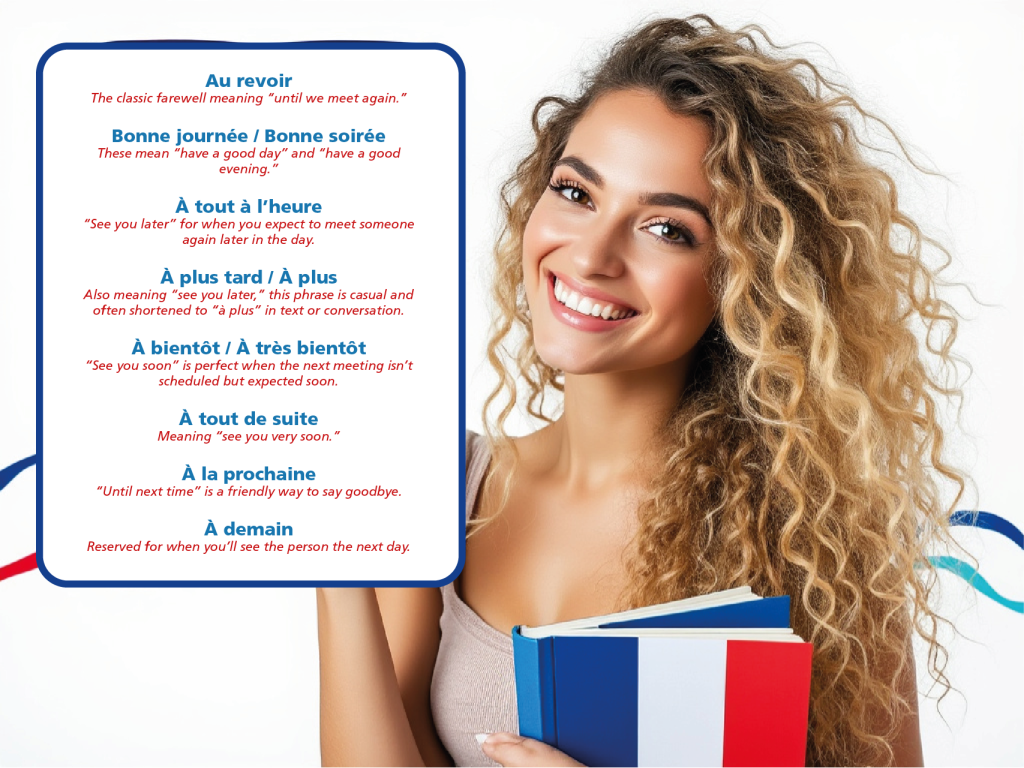
Au revoir
The classic farewell meaning “until we meet again.” Versatile and polite, it’s suitable for most settings, both formal and informal, business meetings, casual chats, or when leaving a shop.
Bonne journée / Bonne soirée
These mean “have a good day” and “have a good evening.” Use “bonne journée” for parting during the day and “bonne soirée” for the evening. Perfect for polite exchanges in shops or after appointments.
À tout à l’heure
“See you later” for when you expect to meet someone again later in the day. Works well in both professional and casual contexts.
À plus tard / À plus
Also meaning “see you later,” this phrase is casual and often shortened to “à plus” in text or conversation. Suitable for friends and informal acquaintances.
À bientôt / À très bientôt
“See you soon” is perfect when the next meeting isn’t scheduled but expected soon. Add “très” for “very soon.” Works well in both formal and friendly contexts.
À tout de suite
Meaning “see you very soon,” it’s ideal for immediate meet-ups. Use it when parting just before a quick follow-up meeting or rendezvous.
À la prochaine
“Until next time” is a friendly way to say goodbye when you don’t know exactly when you’ll see each other again. Suitable for acquaintances and friends.
À demain
Reserved for when you’ll see the person the next day, making it ideal for workplace farewells or with classmates.
Salut
This informal farewell means both “hi” and “bye,” ideal for friends, family, or casual peers.
Au plaisir de vous revoir
“Looking forward to seeing you again” is a warm, polite phrase for professional or social goodbyes, leaving a positive impression.
Bonne continuation
Use “bonne continuation” when parting after a project or event, to wish someone well going forward. Common in professional settings.
Adieu
A serious or dramatic farewell, meaning “to God.” Rarely used in everyday speech. It carries a sense of finality and shows up mostly in literature.
Which casual French farewells will you actually hear?
Casual goodbyes bring a touch of authenticity to everyday interactions. Here are some colloquial phrases commonly heard among French speakers:
- On s’appelle (On sah-pel) – Meaning “let’s call each other,” it’s a friendly way to say “let’s stay in touch.”
- On se tient au courant (On seh-tyen o koo-ran) – Similar to “on s’appelle,” this phrase means “let’s keep each other updated.”
- À tout’ (Ah toot) – A contraction of “à tout de suite” or “à tout à l’heure,” often used informally to say “see you later.”
- À un de ces quatre (Ah uhn deh say kaht) – Translating loosely to “see you one of these days,” it’s a casual, friendly phrase.
- Tchao / Tchuss – Borrowed from Italian and German, these add a European flair to an easygoing farewell.
- Bise / Bisous (Bees / Bee-zoo) – Meaning “kisses,” these are used among close friends or family, often as a warm way to end a conversation.
These phrases add personality and warmth, helping you sound more like a native speaker in casual settings.
Which French goodbye should you pick for which situation?
Each French goodbye has its own tone and usage, allowing you to tailor your farewells to different contexts. Here’s a quick guide to help you choose:
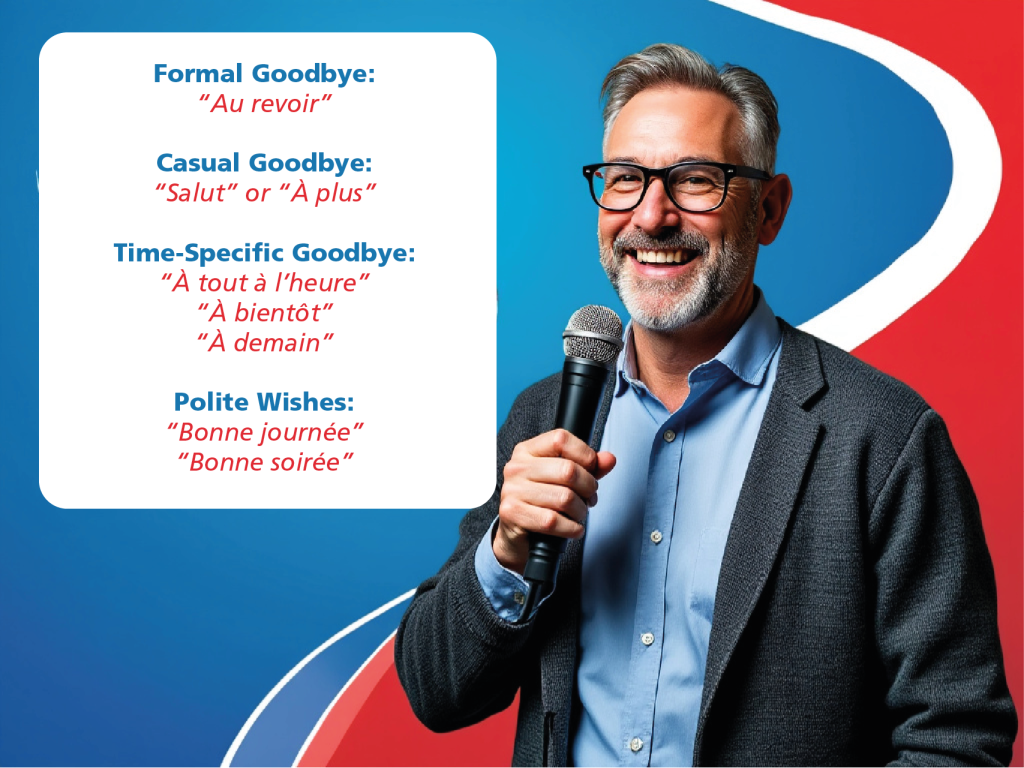
- Formal Goodbye: “Au revoir”
- Casual Goodbye: “Salut” or “À plus”
- Time-Specific Goodbye: “À tout à l’heure,” “À bientôt,” “À demain”
- Polite Wishes: “Bonne journée,” “Bonne soirée”
- Rare or Dramatic Goodbye: “Adieu”
Whether you’re saying goodbye to friends, family, or people you’ve just met, there’s a perfect French expression to match the occasion. Each phrase adds a little nuance to your goodbye, making the interaction more memorable and meaningful.
Why does French pronunciation make even simple goodbyes hard to be understood?
How you say goodbye matters in France. The right farewell signals that you know the customs, not just the words. A simple “au revoir” works almost everywhere. A casual “à un de ces quatre” among friends shows a different register. Either way, a thoughtful goodbye leaves a better impression than a flat one.
Knowing the right phrases is only part of the picture. Getting the pronunciation right matters just as much. French has 14 distinct vowel sounds, and an anglophone brain trained on English filters most of them into a smaller set without realising it. That’s why Real French works on phonetic ear training before anything else, so that when you do say “au revoir,” it sounds the way it should.


Bernard Henusse · Founder, Real French
Bernard founded Real French in 2008 and has taught one-on-one French phonetics in Kerfiac, Brittany ever since. Real French is the world’s only residential French phonetics immersion. Over four hundred adults have completed the fourteen-sound programme.
Want to find out which of the 14 sounds your ear is missing?
Take the three-minute diagnostic to find out which of the 14 French sounds you’re missing. Or book a free fifteen-minute call with Bernard to talk through where you actually are with French and what would close the gap fastest.
400+ students from 30+ countries · 18 years of teaching · Kerfiac, Brittany.