

French language learning methods
The better question is whether French becomes the working language of the day. A group class in France is real French immersion only when it does.
By Theo Henusse · 13-minute read
Key takeaways
- A group class in France is real French immersion only when French becomes the working language of the day.
- French immersion has to include counted exposure: native contact hours, French at meals, a class size small enough for correction to reach you, and a schedule where French is the default condition of the day.
- International group classes stop short of immersion when shared English, uneven levels, and teacher-led turn-taking shrink each learner’s real Oral Interaction time.
- Culture becomes practice when the activity forces the learner to function in French with real people, real timing, and real consequences for misunderstanding.
- A serious one-to-one structure connects Oral Comprehension, The 14 Sounds, pronunciation, sentence repair, and Oral Interaction inside the same daily diagnostic relationship.
In this article
- Is a group class in France real French immersion?
- What does French immersion have to include before the word means anything?
- Why do international group classes often feel intensive without becoming immersive?
- What evidence should a buyer ask for before trusting the promise?
- When does culture become practice, and when is it just tourism in French packaging?
- Why does real immersion need Oral Comprehension before conversation can hold?
- What should one-to-one mean inside a French immersion programme?
- How should you choose a French immersion programme in France now?
Is a group class in France real French immersion?
The better question is whether French becomes the working language of the day. A group class in France is real French immersion only when it does. Location alone proves very little. Adult learners do not simply need more French around them; second-language phonology treats the first difficulty as perceptual, because the ear may fail to register contrasts the mouth is later asked to produce. Bradlow et al. (1997) found that high-variability listening training on a sound contrast improved pronunciation even without speaking practice, which is exactly why a classroom that keeps French safely inside lesson time can feel serious while leaving the real problem almost untouched.
A group course can still be useful. It can explain grammar, supply vocabulary, and give you the rhythm of a school day in France. But immersion asks a harder question: after the class ends, what language carries lunch, corrections, hesitation, jokes, instructions, and ordinary requests? If the answer is English, then French has become a subject surrounded by English recovery time. The 14 Sounds may be named on a worksheet, but Oral Comprehension is not being pressed long enough for your ear to stop treating unfamiliar French sounds as background noise.
Before buying, ask for the daily language rules in plain terms. What language is used at meals, during breaks, in activities, and when students get stuck? Ask who corrects your spoken French outside class, how often you speak to a native speaker, and whether Oral Interaction is protected from the easy slide back into English among international classmates. A group class in France earns the word immersion only when the whole day keeps making you operate in French.
What does French immersion have to include before the word means anything?
French immersion has to include counted exposure: native contact hours, French at meals, a class size small enough for correction to reach you, and a schedule where French is the default condition of the day. Count it. If breakfast, lunch, excursions, transfers, and evening conversation all slide back into English, the word immersion is doing brochure work, because the learner is receiving lessons rather than living enough hours in French for Oral Comprehension and Oral Interaction to be tested repeatedly. Flege et al. (1995) found that perceived foreign accent rose steadily with the age at which 240 native Italian speakers first arrived in the English-speaking environment, a useful warning for adults: the ear starts from a harder place, so immersion has to create pressure you can actually measure, including work on The 14 Sounds.
Why do international group classes often feel intensive without becoming immersive?
International group classes often feel intensive because everyone is busy. They stop short of immersion when the group design lets shared English, uneven levels, and teacher-led turn-taking shrink each learner’s real Oral Interaction time.
The room can sound productive. Questions are answered, worksheets are completed, the teacher keeps the pace moving, and nobody feels idle for long. But spoken French is not only vocabulary arriving quickly; Cutler et al. (1986) found that French and English listeners segment continuous speech using different rhythmic units. For an English-speaking learner, that means a fast group exchange can become a guessing exercise before it becomes Oral Comprehension: where did one word end, where did the next begin, and which syllable carried the clue?
Shared English then becomes the pressure valve. The moment instructions, jokes, meal talk, or confusion are solved in English, the group feels socially fluent while the learner’s French workload drops. Uneven levels make the problem sharper, because the strongest students pull the conversation upward, the hesitant students wait, and the teacher distributes turns so the class stays polite. Pellegrino et al. (2011) found that French is one of the faster, lower-density languages, so the ear may already be working hard before the learner gets a chance to answer. In that setting, ask a blunt buyer’s question: how many minutes per hour will you personally speak French, be corrected on The 14 Sounds, and have to repair your own sentence without the group rescuing you in English?
What evidence should a buyer ask for before trusting the promise?
Before trusting the promise, ask for evidence that shows what happens before, during, and after the stay: sample programme materials, anonymised teacher feedback, and first-hand client accounts that describe correction in use. Generic praise is thin evidence. A useful account names the learner’s problem, what the teacher noticed, how often the learner was corrected, and whether Oral Comprehension or Oral Interaction changed under pressure. The reason to ask for that level of evidence is practical: Best & Tyler (2007) explains that adult listeners perceive unfamiliar sounds by assimilating them to the closest categories in their native language, so a promise about spoken French needs proof that someone will hear your actual French, including mistakes inside The 14 Sounds. Their Perceptual Assimilation Model also explains why French /y/ and /u/ can become hard for many English speakers to tell apart when both are heard through one native category.
Make the decision concrete. Ask the school to send one real weekly timetable, one example of how a teacher records pronunciation or listening errors, and two client accounts detailed enough to show the method at work. If they can supply those materials without turning the reply into brochure language, keep the programme on your shortlist. If the answer stays vague, with beautiful rooms, happy groups, and no trace of diagnosis, correction, or follow-up, treat the word immersion as unproven and move on.
When does culture become practice, and when is it just tourism in French packaging?
Culture becomes practice when the activity forces you to function in French with real people, real timing, and real consequences for misunderstanding. A market visit can do that. A meal can do that. A wine tasting can do that too, if you are asking, answering, listening, repairing your sentence, and catching the reply without someone translating the whole scene back into English. The place helps, but the pressure matters more. Real French operates from Kerfiac, a village in Brittany, the administrative region of western France historically known as Brittany, where immersion students stay at the teacher’s home for three to ten days. That detail matters only because it can put ordinary life close enough to the lesson for the teacher to turn culture into repeated practice.
- Ask who speaks during the activity. If the guide, host, or teacher does almost all the talking, you are attending a cultural presentation.
- Ask what language is used before and after. The useful French often sits in the small moments: arriving, ordering, thanking, clarifying, making a mistake, trying again.
- Ask whether correction happens inside the activity. A teacher who hears your vowel, liaison, rhythm, or missing article in the moment can connect the experience back to The 14 Sounds and to your own Oral Interaction.
- Ask whether the activity creates another attempt. One elegant excursion gives atmosphere. Repeated ordinary exchanges give your ear and mouth something to adjust to.
The reason to be strict is simple: adult learners can still change what they hear, but the contact has to make the difference perceptible. Flege & Bohn (2021) argues that first-language speech-learning mechanisms remain available across the lifespan when the learner comes to perceive how a second-language sound differs from the nearest first-language sound. A cultural programme that protects you from that friction may feel French. It will mostly give you memories. A useful one keeps returning you to the live sentence, the missed sound, the second attempt.
Why does real immersion need Oral Comprehension before conversation can hold?
Real immersion needs Oral Comprehension first because conversation collapses when the ear cannot catch The 14 Sounds inside natural speech. You may know the words on paper and still miss them at speed, because French sounds do not arrive as classroom syllables; they arrive joined, reduced, and shaped by another person’s mouth. Kuhl et al. (2003) found that infants learned new phonetic contrasts from live human interaction, but not from the same material delivered by audio or video alone, which is why Oral Interaction needs a trained ear underneath it.
“International group classes stop short of immersion when shared English, uneven levels, and teacher-led turn-taking shrink each learner’s real Oral Interaction time.”
If something here rang true, book a free 15-minute call with Bernard.
No pitch, no commitment. We talk about where you are in French, what you have tried, and whether the work Bernard does is the right fit.
18 years · 400+ students · 30+ countries
What should one-to-one mean inside a French immersion programme?
One-to-one should mean a daily diagnostic relationship: the teacher hears your French closely enough to identify what your ear is missing, corrects it in the moment, and adapts the next hour because of what happened in the last one. Iverson et al. (2003) found that an adult listener’s native language can warp perceptual space, so some non-native contrasts are heard through the same old category. That matters here because a teacher cannot repair what they never hear you try to say.
A token private hour often gives you privacy, correction, and a pleasant feeling of progress, then leaves the rest of the day untouched. A serious one-to-one structure has a different scope: Oral Comprehension, The 14 Sounds, pronunciation, sentence repair, and Oral Interaction are connected inside the same relationship, so the teacher is not meeting a new version of you each morning.
Ask how the private work is diagnosed on day one, how errors are tracked, and how the teacher changes the plan when the same sound or listening failure returns. Ask for a concrete answer, not a timetable label. Vandergrift (2007) documents that second-language listening is an active skilled process and that learners taught metacognitive listening strategies understand spoken language measurably better than learners left to absorb it passively. In buyer terms, one-to-one should show you where your French breaks under attention, then give you repeated, corrected attempts until the teacher can hear that something has changed.
How should you choose a French immersion programme in France now?
Choose the French immersion programme whose ordinary day can be checked before you book: who speaks French with you, when correction happens, how Oral Comprehension is trained, and how much Oral Interaction you personally have to sustain. Ask for the timetable, the language rules outside class, the size of the teaching relationship, and the way pronunciation is diagnosed, because a serious programme can show where The 14 Sounds enter the work instead of hiding behind the large word immersion. Be wary of confident phrasing. A brochure can make any stay in France sound complete. The better test is whether the design would still look immersive if you removed the photos, the city name, and the adjectives, leaving only the daily conditions that force you to hear, answer, be corrected, and try again in French.
Frequently asked questions
Is a group class in France real French immersion?
The better question is whether French becomes the working language of the day. A group class in France is real French immersion only when it does. Location alone proves very little. Adult learners do not simply need more French around them; second-language phonology treats the first difficulty as perceptual, because the ear may fail to register contrasts the mouth is later asked to produce. Bradlow et al. (1997) found that high-variability listening training on a sound contrast improved pronunciation even without speaking practice, which is exactly why a classroom that keeps French safely inside lesson time can feel serious while leaving the real problem almost untouched.
What does French immersion have to include before the word means anything?
French immersion has to include counted exposure: native contact hours, French at meals, a class size small enough for correction to reach you, and a schedule where French is the default condition of the day. Count it. If breakfast, lunch, excursions, transfers, and evening conversation all slide back into English, the word immersion is doing brochure work, because the learner is receiving lessons rather than living enough hours in French for Oral Comprehension and Oral Interaction to be tested repeatedly. Flege et al. (1995) found that perceived foreign accent rose steadily with the age at which 240 native Italian speakers first arrived in the English-speaking environment, a useful warning for adults: the ear starts from a harder place, so immersion has to create pressure you can actually measure, including work on The 14 Sounds.
Why do international group classes often feel intensive without becoming immersive?
International group classes often feel intensive because everyone is busy. They stop short of immersion when the group design lets shared English, uneven levels, and teacher-led turn-taking shrink each learner’s real Oral Interaction time.
What evidence should a buyer ask for before trusting the promise?
Before trusting the promise, ask for evidence that shows what happens before, during, and after the stay: sample programme materials, anonymised teacher feedback, and first-hand client accounts that describe correction in use. Generic praise is thin evidence. A useful account names the learner’s problem, what the teacher noticed, how often the learner was corrected, and whether Oral Comprehension or Oral Interaction changed under pressure. The reason to ask for that level of evidence is practical: Best & Tyler (2007) explains that adult listeners perceive unfamiliar sounds by assimilating them to the closest categories in their native language, so a promise about spoken French needs proof that someone will hear your actual French, including mistakes inside The 14 Sounds. Their Perceptual Assimilation Model also explains why French /y/ and /u/ can become hard for many English speakers to tell apart when both are heard through one native category.
When does culture become practice, and when is it just tourism in French packaging?
Culture becomes practice when the activity forces you to function in French with real people, real timing, and real consequences for misunderstanding. A market visit can do that. A meal can do that. A wine tasting can do that too, if you are asking, answering, listening, repairing your sentence, and catching the reply without someone translating the whole scene back into English. The place helps, but the pressure matters more. Real French operates from Kerfiac, a village in Brittany, the administrative region of western France historically known as Brittany, where immersion students stay at the teacher’s home for three to ten days. That detail matters only because it can put ordinary life close enough to the lesson for the teacher to turn culture into repeated practice.
Why does real immersion need Oral Comprehension before conversation can hold?
Real immersion needs Oral Comprehension first because conversation collapses when the ear cannot catch The 14 Sounds inside natural speech. You may know the words on paper and still miss them at speed, because French sounds do not arrive as classroom syllables; they arrive joined, reduced, and shaped by another person’s mouth. Kuhl et al. (2003) found that infants learned new phonetic contrasts from live human interaction, but not from the same material delivered by audio or video alone, which is why Oral Interaction needs a trained ear underneath it.
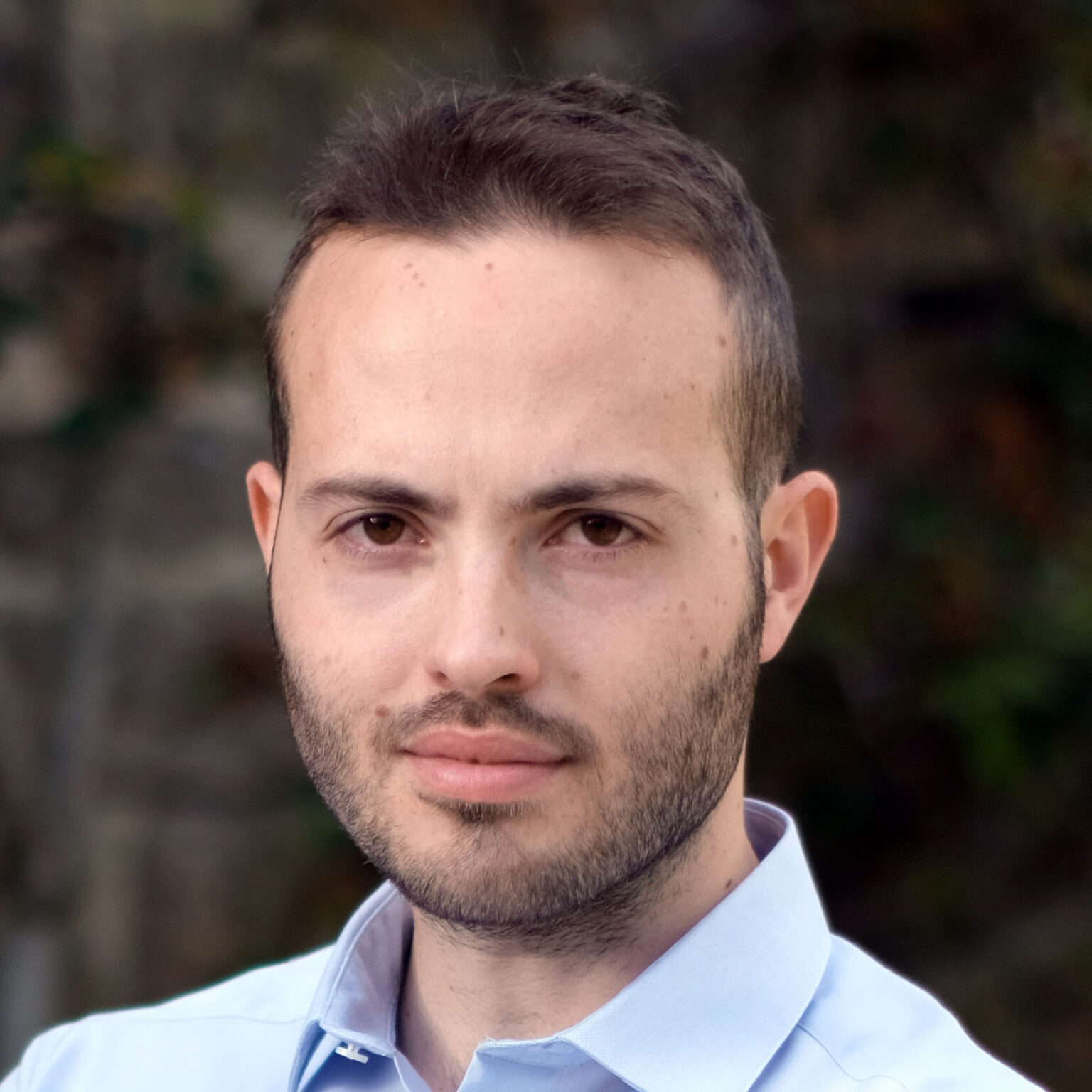
Theo Henusse · Co-director and Pronunciation Expert
Theo runs the production side of phonetic ear training at Real French. Near-native English speaker after six years in London, musician with a trained ear for phonetic precision. Works alongside Bernard to drill the precise sound adjustments that turn an English-accented vowel into a French one.
If something here rang true, book a free 15-minute call with Bernard.
No pitch, no commitment. We talk about where you are in French, what you have tried, and whether the work Bernard does is the right fit.
18 years · 400+ students · 30+ countries